Yoga for Stress Relief: A Complete Guide to Calming Your Mind and Body
If your shoulders live somewhere near your ears and your to-do list never seems to shrink, you’re not alone. Modern life keeps our nervous systems on high alert, and that constant low hum of tension takes a real toll on sleep, digestion, and mood. Yoga for stress relief has become one of the most searched wellness solutions for a reason: it works with the body’s own relaxation response rather than fighting against it. This guide walks through the science, the poses, the breathing techniques, and a simple daily routine so you can start using yoga to relieve stress today.
Understanding Stress and Why Yoga for Stress Relief Works
How Chronic Stress Affects Your Body
Stress isn’t just a feeling—it’s a physical event. When your brain perceives a threat, real or imagined, it releases cortisol and adrenaline, your heart rate climbs, and your muscles tighten in preparation to fight or flee. This is useful for a genuine emergency, but most modern stress (email overload, traffic, deadlines) doesn’t need a fight-or-flight response. Left unresolved, this cycle shows up as tense shoulders, shallow breathing, poor sleep, and a racing mind. Check out our Instagram page.
The Science Behind Stress-Relieving Yoga
Yoga interrupts this cycle by activating the parasympathetic nervous system—the “rest and digest” counterpart to the stress response. A 2024 systematic review in the International Journal of Yoga found that combining postures, breathing, and meditation measurably shifts biosignals associated with stress, including heart rate and brainwave activity. In short, this stress-relieving effect of yoga isn’t just anecdotal; it has a documented physiological basis.
Best Yoga Poses for Stress Relief
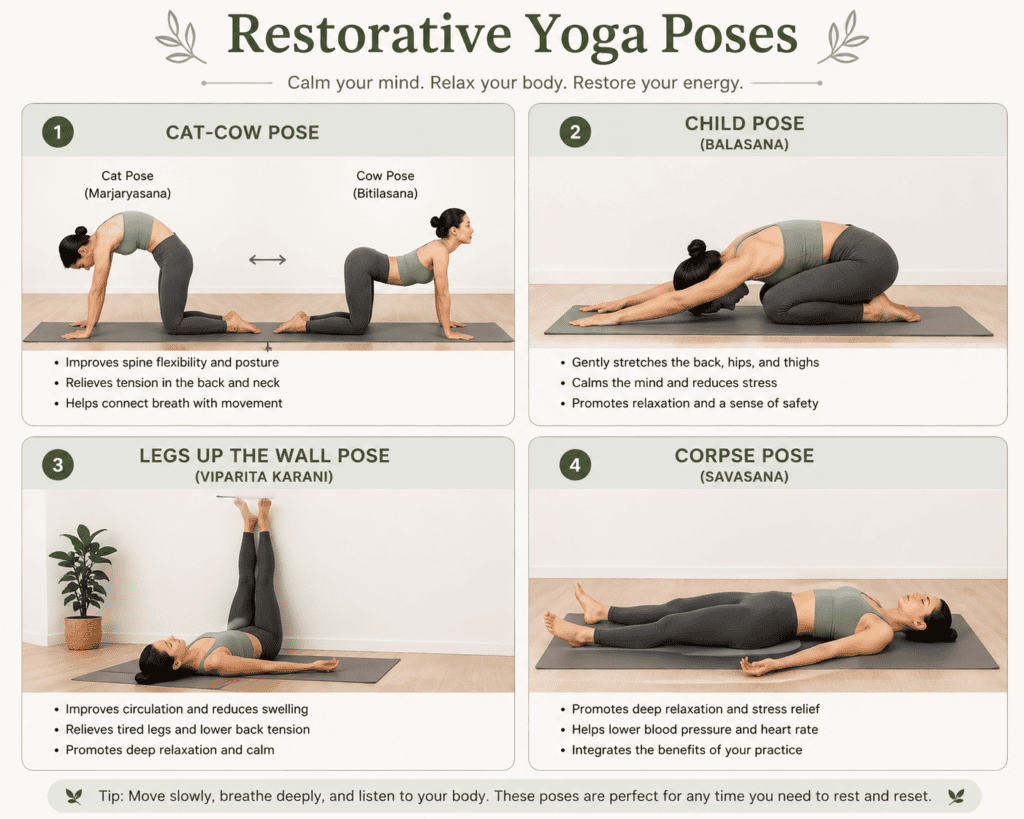
These four poses are staples of almost every stress-relief sequence, and each targets a different part of the body’s tension response.
Child's Pose (Balasana)
Kneel with your big toes touching, knees wide, and fold your torso forward, resting your forehead on the mat. Balasana calms the nervous system while gently stretching the hips, back, and shoulders—areas that tend to hold the most tension.
Cat-Cow Pose (Marjariasana-Bitilasana)
On hands and knees, inhale as you arch your back and lift your gaze (Cow), then exhale as you round your spine and tuck your chin (Cat). This slow, breath-linked movement is one of the most accessible entry points into a stress-relief yoga practice because it requires no flexibility, only rhythm.
Legs-Up-the-Wall Pose (Viparita Karani)
Lie on your back with your legs resting up a wall, arms relaxed at your sides. This gentle inversion encourages blood flow back toward the heart and is often recommended for winding down before bed.
Corpse Pose (Shavasana)
Lying flat with eyes closed, Shavasana looks like doing nothing—but it’s arguably the most important pose in any stress-relief sequence, giving the nervous system time to fully settle after movement.
Pranayama: Breathing Techniques That Support Yoga for Stress Relief
Breathwork, or pranayama, is often the fastest-acting tool in the stress-relief toolkit because you can use it anywhere, not just on a mat.
Nadi Shodhana (Alternate Nostril Breathing)
Using your thumb and ring finger to alternate closing each nostril, this technique is believed to balance the nervous system and is frequently recommended for anxiety and emotional overwhelm.
Ujjayi Breath (Ocean Breath)
A slight constriction at the back of the throat creates a soft, ocean-like sound with each inhale and exhale. Ujjayi breathing slows respiration and gives the mind a single point of focus, which is especially useful during a stressful day.
Which Type of Yoga Is Best for Stress and Relaxation?
Restorative Yoga
Poses are held for several minutes with props like bolsters and blankets, allowing full muscular release. This is often the most direct route to stress relief through yoga for people who feel constantly “wired.”
Hatha Yoga
A slower-paced style that blends postures and breath without the intensity of a flow class, making it approachable for beginners seeking calm rather than a workout.
Yoga Nidra
Sometimes called “yogic sleep,” this guided practice is done lying down and leads practitioners into a deeply relaxed, meditative state—ideal on days when active movement feels like too much.
A Simple 15-Minute Yoga for Stress Relief Routine
Step 1: Centering (2 minutes)
Sit comfortably and take five slow Ujjayi breaths to settle in.
Step 2: Cat-Cow (3 minutes)
Move through 10–12 rounds, syncing breath with movement.
Step 3: Child's Pose (3 minutes)
Hold and focus on lengthening each exhale.
Step 4: Legs-Up-the-Wall (4 minutes)
Let gravity do the work while you breathe naturally.
Step 5: Shavasana (3 minutes)
Close with stillness, letting the nervous system fully reset.
Tips to Get More From Your Stress-Relief Yoga Practice
Consistency beats intensity. Ten focused minutes daily outperforms one long weekly session.
Breathe through the nose wherever possible to naturally slow your heart rate.
Use props. A cushion or folded blanket makes restorative poses more sustainable.
Practice without judgment. Wandering thoughts are normal; gently return attention to the breath.
Pair it with your existing routine, such as right before bed or after work.
Frequently Asked Questions
Is yoga really effective for stress relief?
Yes. Research links regular yoga practice to lower cortisol, reduced resting heart rate, and improved emotional regulation, largely through its effect on the parasympathetic nervous system.
How often should I practice yoga for stress relief?
Even 15–20 minutes, three to four times a week, can produce noticeable changes in mood and tension. Daily practice offers the most consistent results.
Can complete beginners do yoga for stress relief?
Absolutely. The poses and breathing techniques covered here require no prior experience or special equipment—just a quiet space and a few minutes.
What is the best time of day for yoga for stress relief?
Morning practice can set a calmer tone for the day, while an evening session helps unwind before sleep. Both are effective; choose whichever you’re more likely to stick with.
Conclusion
Yoga for stress relief works because it addresses stress at its physiological root, not just its symptoms. A few consistent minutes of breath-linked movement can shift your body out of high alert and into genuine rest. Start small, stay consistent, and let the practice build from there. Check out our other blogs.